Arabic AI is moving from models to agents: reading HUMAIN's latest announcements
5 min read
Three announcements in five weeks: a large Arabic model in research preview, Arabic-speaking agents with Napster, and an operations service with EY. What is actually available today, what is still a promise, and what it means for anyone building Arabic products.
In roughly five weeks, HUMAIN, the Public Investment Fund's AI company, announced three moves that are worth reading together: a large Arabic language model in research preview, a partnership to deliver Arabic-speaking "digital employees," and a third partnership to build an agent-driven business operations service.
The quick read says Arabic AI has arrived. The more careful read says the center of gravity is shifting from "who has the best Arabic model?" to "who puts the model inside real work?" And along the way, a meaningful part of what was announced is still a promise, not a delivery.
This note separates three levels: what is available today, what is only announced, and what it means for anyone building an Arabic product.
1. The model: in research preview
On September 3, 2026, at LEAP in Riyadh, HUMAIN announced humain-m3. According to the official release, the model was commissioned by HUMAIN and delivered by MiniMax, and it builds on the MiniMax-M3 lineage with further pre-training on more than one trillion tokens of Arabic-native content.
What the company states about the model:
- Size: 428 billion parameters in a mixture-of-experts design, with about 23 billion active per token, according to the platform page.
- Stated capabilities: text, image and video understanding; tool use and computer use; and three thinking modes: always on, adaptive, and off.
- Access: a limited preview on HUMAIN Node, with a no-code playground and an API compatible with OpenAI SDKs. Access requires a request and approval. The limited preview runs with a Saudi alignment guardrail, while the research preview offers the full checkpoint.
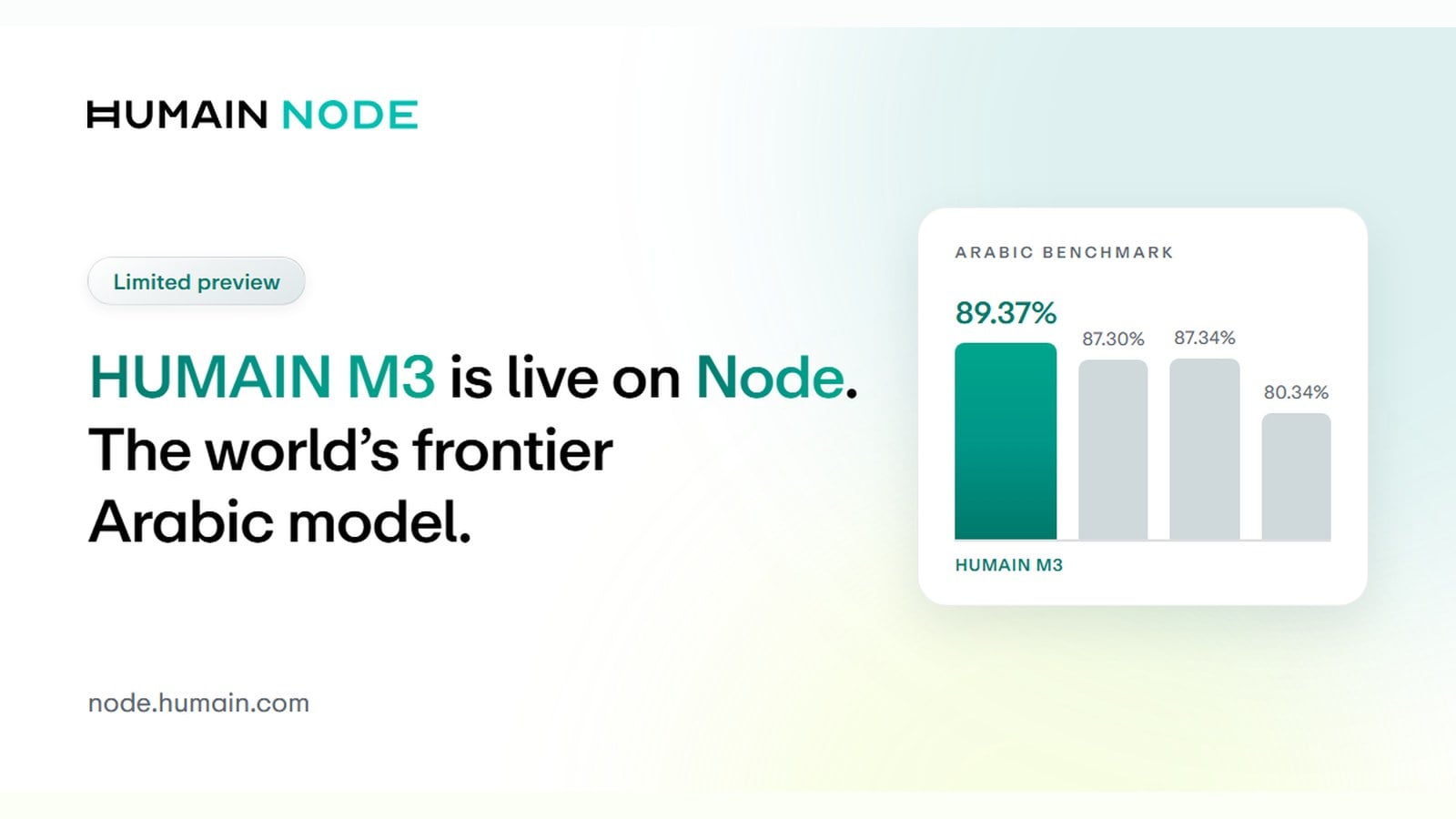
On the numbers: HUMAIN says the model achieved the highest average among the models it compared on seven public Arabic benchmarks: 89.37% versus 87.30% and 87.34% for the two strongest models in its comparison. These are the company's own evaluation results. A TechTimes report noted that the evaluation ran on HUMAIN's infrastructure and that, as of its publication, the scores had not been submitted to the Open Arabic LLM Leaderboard, where Arabic models are compared on a common pipeline.
On open weights: HUMAIN said it expects to release the weights under the MiniMax Community License after safety training and alignment, with a stated target of "next month," meaning October. When this article was written on October 8, the platform page listed the weights as "coming soon," and as of October 9 I could not find the new model's weights published on Hugging Face.
One practical point: according to TechTimes, MiniMax's license for its base model requires a separate commercial agreement for revenue-generating use. We will not know the exact terms for the Arabic model until its license text is published.
2. The agent: with Napster
On October 6, HUMAIN and Napster, a US company focused on multimodal agents, announced a partnership. According to Middle East AI News, reporting on the announcement, it combines HUMAIN's ALLaM model and speech recognition, plus text-to-speech from SawtArabi, with Napster's video presence and agent platform.
The described result: agents that understand and speak Arabic, keep conversation history across sessions, and interact with customers and colleagues through voice, video and text. The announcement says the underlying model was shaped by more than 600 Arabic language and cultural experts. Napster plans to offer these capabilities to its existing public and private sector clients in Saudi Arabia and the region.
What I did not find in the sources I reviewed: pricing, specific availability dates, or named organizations already using it.
3. Operations: with EY
On October 1, Arab News reported that HUMAIN and EY MENA are expanding their collaboration to build what they describe as Saudi Arabia's first AI-native business process outsourcing service. HUMAIN provides the technology, infrastructure and agent ecosystem; EY contributes development, commercialization, and expertise in finance, audit, tax and advisory.
For builders, what was not announced matters most: financial terms, a commercial launch date, and customer or revenue targets were not disclosed, as Arab News states plainly.
The bigger picture: from a model race to a layer race
Put the three announcements side by side and three layers appear:
- The model layer: a large Arabic model being tested now, with open weights still pending.
- The agent layer: voice, memory and visual presence on top of an Arabic model.
- The operations layer: agents embedded in how organizations actually run.
The value an end user feels is likely created in the second and third layers, not in the benchmark table alone; this is an inference from reading the announcements, not a stated fact.
What this means if you build Arabic products
1. Test it yourself before trusting the tables. Prepare a small set of questions from your real product, in your users' dialect and your domain's vocabulary, and run every model through it before building on it. A seven-benchmark average will not tell you how a model handles a customer typing in their own dialect.
2. Use API compatibility to your advantage. HUMAIN Node exposes the model through an OpenAI-compatible API. If your product is built that way, trying a new model may take little more than changing the base URL, key and model name. Make the model choice a configuration setting, not a decision buried in code.
3. Separate the model layer from the product layer. Napster describes its platform as running on top of any model. The same lesson applies to your product: memory, human handoff, tone and voice experience are value you own, whatever model sits underneath.
4. Read the license before planning self-hosting. "Open weights" does not always mean "free for commercial use." Wait for the actual license text before reserving hardware or promising a client anything.
5. Voice and dialect are still open ground. All three announcements point to voice and natural Arabic conversation. If your product serves a Saudi audience, testing dialect in spoken, not only written, language may be the most important test you run.
What I will watch next
- The weights actually shipping, with the full license text.
- Independent evaluation results on the Open Arabic LLM Leaderboard or from researchers outside the company.
- The first announced deployment of Napster's Arabic agents with a named organization.
- Details of the HUMAIN and EY service at commercial launch.
I will update this note when any of these appears with a verifiable source.
Sources
- HUMAIN's official humain-m3 announcement, September 3, 2026
- The humain-m3 page on HUMAIN Node
- TechTimes analysis of the benchmark claims and licensing, September 4, 2026
- Middle East AI News on the Napster partnership, October 6, 2026
- Arab News on the HUMAIN and EY outsourcing service, October 1, 2026
Cover image: official image from HUMAIN Node.
Abdulrahman Alshehri — Building What's Next.